Monday

Jack Church

This is Jack Church. He is one of only two players in NHL history with that last name. Brad Church, who played 2 games with Washington in 1997-98, is the other.

Jack Church, a defenseman from Kamsack, Saskatchewan played in 130 NHL games in the years surrounding World War II.  Best remembered as a Leaf, though he also played with the Brooklyn Americans and Boston Bruins, he scored 4 career goals and 23 career points.

Read more...

Tuesday

Ernie Dickens

This good looking young man is Ernie Dickens. The defenseman from Winnipeg, Manitoba made a favorable impression as a rookie with the Toronto Maple Leafs, helping the Leafs come back from 3 games down to defeat Detroit in the Stanley Cup finals.

But Dickens had to put his NHL aspirations on hold. After his rookie season he was summoned off to the Canadian military as part of the effort in World War II.

Dickens did not return until 1945. He played one more season with the Leafs, but was no longer the highly anticipated youngster. In fact, he was replaced by the next star young defenseman - Bashin' Bill Barilko. Dickens spent most of the next couple of seasons in the minor leagues before he was moved to Chicago as part of the big Max Bentley trade.

Dickens played four seasons in Chicago, quietly providing reliable defense with the Hawks.


Read more...

Sunday

Pete Backor

Fort William, Ontario (better known today as Thunder Bay) has always been a hotbed for hockey, but especially back in the early days. Brothers Pete and Hank Backor were both excellent players with the Fort William Forts. While they both dreamed of playing in the National Hockey League and both would enjoy long professional careers, only Pete would make it to the big leagues.

Pete didn't make the jump to pro hockey any too soon though. The defenseman found a good spot with the senior league St. Catherines Saints, playing and working in the southern Ontario town for five years during World War II.

The war was nearing an end by 1944-45, but the Toronto Maple Leafs still needed replacements with many of their players still under commitment to the Canadian military. Backor was brought in to play on the blue line that season. A good offensive defenseman, Backor scored 4 goals and 9 points in 36 games.

That would be Backor's only taste of NHL action, seeing as that many of the conscripts would return to the Leafs the following season. He was sent to the Leafs' AHL farm team in Pittsburgh where he would star with the Hornets until 1954. He was a 5 time all star and in 1952 he led the Hornets to the Calder Cup championship.

Backor, who was Rudy Migay's brother in-law, returned to Ontario late in his career to play some senior and semi-pro hockey. He retired in 1956.

Read more...

Friday

Inge Hammarstrom


Hammarstrom was born in Sundsva back in January of 1948. The son of an engineer, he was raised in the paper mill town of Timre.

Hammarstrom grew up playing a lot of sports, but he excelled at two: tennis and especially hockey. By 15 he was named to the Swedish national junior team and was a regular on the senior national team at 19 years old.

Despite his success, he never gave much thought to a career in the National Hockey League. European players were all but non-existent in the early 1970s. But that changed in large part to Hammarstrom and his good friend, Borje Salming.

On May 12th, 1973 the Toronto Maple Leafs signed the two Swedes. The 21 year old Salming would go on to become a Hockey Hall of Famer and one of the best defenseman in the NHL for the next 15 seasons.

Hammarstrom, who was 25 when first arrived, was not so lucky. He averaged more than 20 goals a year in four seasons with the Leafs, but he did not adapt well to the harder hitting style of play in North America. And miscreant Leafs owner Harold Ballard made sure Hammarstrom was labelled as soft for all of eternity, famously stating, “Hammarstrom could go into the corner with a dozen eggs in his pocket and not break any of them."

The charge was unfair. Canadian players like Jean Ratelle or the Leafs own legendary Dave Keon played the game cleanly and without malice, but Hammarstrom was vilified largely because he was European.

A superb skater and stickhandler, Hammarstrom was strong in his convictions about how the game should be played.

"My game is the one of skills we were taught in Sweden. We also were taught self discipline. I hate to be roughed up and am tempted to drop my gloves and fight at times, but I do not believe that is the way the game should be played."

Hammarstrom stayed with the Leafs for 4 seasons before moving on to St. Louis for 2 more NHL season. He returned to Sweden to play for Byrnas, and later retiring in beautiful Gavle on the Baltic Sea, spending time on his boat and playing badminton. Yes, badminton.

"It takes more skill than most people realize and it's a shame it isn't played by more people."

But he also spent a lot of time watching hockey games all across Europe. From 1990 through 2008 Hammarstrom served as the chief European scout for the Philadelphia Flyers. His best find - Peter Forsberg.

Read more...

Monday

Busher Jackson

Mostly forgotten by today's fans, Harvey "Busher" Jackson ranks as one of the greatest and most controversial players in Toronto Maple Leafs history.

Conn Smythe signed 18 year old Busher (the youngest player in the league) and Charlie Conacher in 1930 and immediately placed both of them on "The Kid Line" with Joe Primeau at center. They would become hockey's dominant line for the next few years, and would win the Stanley Cup in 1932. Jackson, a power forward long before anyone coined the term, led the whole league in scoring in 1932 and was recognized as an All Star in 5 of the following six years.

When Primeau retired Busher and brother Art Jackson teamed up with Pep Kelly for a while before Busher found a home on a line with Syl Apps and Gordie Drillon in 1937.

Hap Day remembered Busher's jet-like speed - as fast as the legendary Howie Morenz some insisted.

"Busher is so fast that one night in Montreal he circled his net, started down ice, and shot the puck when he was nearing center. And you know what? He was travelling so fast that he caught up with the puck and passed it before he got to the blue line."

Okay, Day had to be exaggerating there. But there was little doubt that Busher was the class of the league. Frank Selke Sr. once remembered Jackson as "the classiest left winger I ever saw.

For all of Busher's on-ice greatness, Leafs boss Conn Smythe grew increasingly disenchanted with Jackson. Jackson, you see, was quite the party boy and a heavy drinker. Smythe, a strict disciplinarian with elitist standards, despised Jackson's behaviour. As a result there was no denying the two were at odds until Jackson's inevitable departure in 1939.

Jackson, coming off a dislocated shoulder, was traded off to the New York Americans with Buzz Boll, Doc Romnes, Jimmy Fowler and Murray Armstrong in exchange for Sweeney Schriner. Schriner would go on to become a favorite of Smythe. Jackson, meanwhile, played (alongside Lorne Carr and Murray Armstrong) two unsatisfactory years in New York. The cash-strapped Amerks sold Jackson off to Boston in 1942.

Reunited with his brother Art in Boston, Busher was hot and cold in Boston in his final 3 years in the NHL. He often played on a line with Art. Bill Cowley and Herb Cain were regular linemates as well. Busher even played some defense in Boston.

Conn Smythe's disdain for Jackson's lifestyle continued long after Jackson hung up his blades. Based on his ability, there was no doubt Jackson belong in the Hockey Hall of Fame. After all, his 241 career goals in Toronto remained a Leafs all time record until Frank Mahovlich broke it in the 1960s. But Smythe blocked any and every attempt to induct Jackson into the Hockey Hall of Fame.

The HHOF embargo was finally lifted in 1971 when Jackson was inducted. Unfortunately Jackson's enshrinement came five years after his death. The respect he so struggled to get and truly deserved never came in time for Jackson. For Smythe, who resigned as president of the Hall after Jackson's inclusion, it was his lowest act.

Read more...

Sunday

Tom "Windy" O'Neill

Tom "Windy" O'Neill put aside his education and a career as a lawyer to play in the National Hockey League. But he would soon return to school and then the courts and enjoyed a lengthy career as a lawyer in Toronto.

The attended famous St. Michael's school and hockey program in the early 1940s. It was at St. Mikes that he earned his interesting nickname. No, it had nothing to do with his speed on the ice or any gastrointestinal issues. No, he was dubbed Windy by a priest at school who did not take well to his long winded debates!

A law career may have been his realistic goal, but a shortage of NHL players due to Canada's efforts in World War II opened the door for O'Neill to play with the Leafs for two seasons.

In 1943-44 O'Neill played in 33 games and scored 8 goals and 15 points. The following season O'Neill again played in 33 games, but his production fell off, scoring just twice with five assists. He did not play in the playoffs, which is unfortunate as the Maple Leafs won the Stanley Cup that year.

When he did play he was utilized strictly as a defensive forward. In fact, one story has coach Hap Day instructing O'Neill to never cross the other team's blue line. Not much of a claim to hockey fame, though he was dubbed "the best piano player in the National Hockey League" by writer Scott Young. He was a very good musician.

O'Neill moved on from the NHL after that season. He originally moved to Vancouver to be a sports reporter for The Vancouver Sun newspaper, but he soon moved back east. He spent a season in Quebec City playing senior hockey with the Aces, and then 3 seasons in Halifax. All the while he studied law, first at Laval University (where he also studied French which, along with Italian and English, would make him trilingual) and then Dalhousie.

Interestingly, his legacy in the maritimes has more to do with football than hockey. He served as president of the Athletic Union at Dalhousie and was instrumental in bringing collegiate football to Canada's east coast.

Upon his return to Toronto he made some of his biggest impact on the NHL. He, along with Lionel and Charlie Conacher, founded the NHL Oldtimers Association to represent the Alumni of the NHL. Years later that organization was instrumental in the pension fight to reclaim $50 million dollars taken by the NHL from the pension fund.

O'Neill was a devoted member of the Liberal Party, though he failed to win a federal seat for the party in 1958.

Windy O'Neill died suddenly of a heart attack in 1973. He was just 49 years old.

Read more...

Johnny McCreedy

John McCreedy only played two seasons in the National Hockey League. But both times he helped the Toronto Maple Leafs defeat the Detroit Red Wings in epic 7 game showdowns.

The first came in 1942. That was the magical year when Toronto erased a 3-0 series deficit to win four games in a row and steal the Stanley Cup right out of the hands of the Red Wings.

McCreedy remained in Toronto the next two seasons, but served with the Royal Canadian Air Force rather than the Maple Leafs. But he returned to the Leafs in the 1944-45 season, again helping the Leafs defeat the Wings for the Stanley Cup.

McCreedy hung up his blades after that championship and returned to University.

He had dropped out of school and left his native Winnipeg after winning the Memorial Cup in 1937. He moved to Trail, British Columbia. He made a good living there for two seasons, working for Cominco and playing for the about-to-be famous Smoke Eaters. Not only did they win the Allan Cup in 1939 as Canada's amateur champs, but they represented the nation at the 1939 World Championships, winning gold before touring the continent.

McCreedy headed to the mining town of Kirkland Lake, where the Blue Devils won the Allan Cup in 1940. Due to the World War the World Hockey Championships were cancelled, so McCreedy never had a chance to return to Europe.

The following year McCreedy moved to Sydney, Nova Scotia and led the Millionaires hockey team right back to the Allan Cup finals, only to come up short to the Regina Rangers.

That's a pretty amazing record - two Stanley Cups, two Allan Cups, 1 Memorial Cup and 1 World Championship all in a span of 8 seasons!

By the way, Mr. McCreedy earned his bachelor of science in mining and joined nickel giant INCO in 1949. He stayed with the company and became Vice Chairman in 1979.

Interestingly, McCreedy played a significant role the creation of one of hockey's most cherished trophies. When the Canada Cup tournament became a reality starting in 1976, McCreedy had INCO finance the famous half maple leaf trophy. Interestingly the original trophy was made of solid nickel, weighed 125 pounds and cost $50,000 to make! INCO made a much lighter, nickel plated trophy for the subsequent tournaments.

Read more...

Bob Davidson

To younger fans Bob Davidson may be better known as a famous Leafs scout. He spent 3 decades as a scout for the Maple Leafs, often putting in long hours and miles with little fanfare or thanks. He spotted many of the Leafs great players over that time, including Frank Mahovlich, Dave Keon and Carl Brewer.

But there was also a time when he was a beloved member of the on-ice Toronto Maple Leafs too.

From 1935 through 1946 Davidson earned a reputation as a hard working winger better known for his two-way play than his offense. From 1935 through 1942 Davidson's career high was just 8 goals. During the diluted era of World War II when the NHL lost many of its players to military commitments, Davidson emerged as a moderate scoring threat. He reached double digits from 1942 through 1945. He topped out at 19 goals and 47 points in 1943-44.

Although he often played on the Leafs' top line with Syl Apps and Gord Drillon - the DAD Line - offense wasn't a true measure of Davidson's value to the Maple Leafs. He was a physical yet usually clean checker known affectionately as "Rugged Robert." Davidson earned the reputation as one of the top defensive forwards in the game during his 12 year career. He accomplished this by perfecting the now-commonly used though illegal ploy of "clutching and grabbing." Davidson was an expert at it. He knew how to interfere with his check just enough to keep him from getting open for a shot without getting a penalty himself. Davidson, despite his reputation, spent very little time in the penalty box - in his career he spent 398 minutes in the penalty box in nearly 500 games.

A disciple of coach Hap Day's tight checking brand of defense, Davidson often drew the assignment of checking the top right winger on the opposing team many nights in his 491 game career in the NHL. Davidson was a wily veteran by the time Montreal's volcanic right winger Maurice Richard arrived in the league, but his battles with "The Rocket" are often more remembered than any other battles.

Unfortunately for Davidson, most hockey history books that refer to Davidson often bring up game 2 of the Stanley Cup semi-finals in 1944. Toronto was facing Montreal and Richard was particularly hot, scoring 23 goals in his last 22 games. Much hype was made when it became obvious that night that the Leafs were employing Davidson against Richard in the tightest of fashions. Anywhere the Rocket went, so would Davidson, even if the play was 100 feet away. Davidson's only job that night was to worry about Richard at all times, and not to help out his other teammates defensively or offensively.

Davidson's clutching and grabbing successfully frustrated Richard in the first period. But Richard broke loose in the second frame, scoring a hat trick. Richard potted two more in the third as Montreal won the game 5-1. It was one of the single greatest performances by one player in National Hockey League history.

Experts agree that Richard's legendary night was more of a reflection of Richard's greatness than Davidson's ability. It is too bad for Davidson that this one night is the one that seems destined to be remembered in his career, as he was truly a great defensive forward much like a Bob Gainey or Guy Carbonneau of modern times. He personified the word industrious as much as any hockey player ever has, and he deserves to be remembered as such.

Davidson was born in Toronto on February 10, 1912, and lived every Toronto kid's dream. He grew up to become a junior star in the city, most notably with the Toronto Canoe Club and Toronto City Services junior hockey team before graduating to the Toronto Marlboros in 1932. In 1933 he joined the Marlies senior team before turning professional in 1934.

Davidson spent parts of two seasons apprenticing in the minor leagues with the International Hockey League's Syracuse Stars. But by 1936 he was a full time member of the hometown Toronto Maple Leafs! He would enjoy more than a decade's run with the Leafs highlighted by 2 Stanley Cup championships and a career 2 year reign as captain of the most fabled team in English Canada!

In the late 1970s Davidson's 40-plus year affiliation with the Leafs came to cruel end. Harold Ballard axed his pay in half, and a heartbroken Davidson resigned in disgust. Ballard was unexplainably eliminating anything and anyone that was a part of the Maple Leafs glorious past. Davidson, like so many others, did not deserve to be treated the way he had been.

Davidson passed away at the age of 84 on September 28, 1996. Both his son (Jim) and grandson (Bryce) have also played minor professional hockey.

Read more...

Wednesday

Corb Denneny

Corb Denneny, the lesser known brother of Hall of Famer Cy Denneny, was a pretty good hockey player in his own right. And a heck of a lacrosse player, too. He started playing pro lacrosse at the age of 14!

But it was hockey where Corb made his name. The Cornwall native enjoyed his best hockey years in Toronto, be it with the NHA Ontarios and Blueshirts and the NHL Arenas, St. Patricks and Maple Leafs. He also briefly played in Ottawa (NHA), Hamilton and Chicago (NHL) before heading out west. The vagabond enjoyed years in Saskatoon, Minneapolis and Newark.

Corb was not as prolific of a scorer as his brother, but he is one of the few NHL players to score 5 goals in one game (vs Hamilton on January 26th, 1921). He was at his best when playing on a line with hard hitting Reg Noble and sniper Babe Dye.

A Stanley Cup champion in 1918 and 1922 (and a finalist on three other occasions), Denneny finished in top 6 in NHL points in three seasons and in NHL goals in four seasons. Yet he never quite got the accolades for big brother Cy. The most common adjective hockey history seems to have assigned him is "solid."

Read more...

Saturday

Art Smith

This is Art Smith. In the late 1920s he played 3 seasons with Conn Smythe's Toronto Maple Leafs and another season with the Ottawa Senators. In 144 NHL games he picked up 15 goals, 25 points and truculent 249 PIMs.

Smith was an all around athlete. He played with the Toronto Argonauts football club and was an oarsman for the Toronto Canoe Club.

Art passed away in Toronto on May 15th, 1962. He just completed a business trip to Europe for Art Smith Construction Supply Ltd., when he passed suddenly at home.

Read more...

Monday

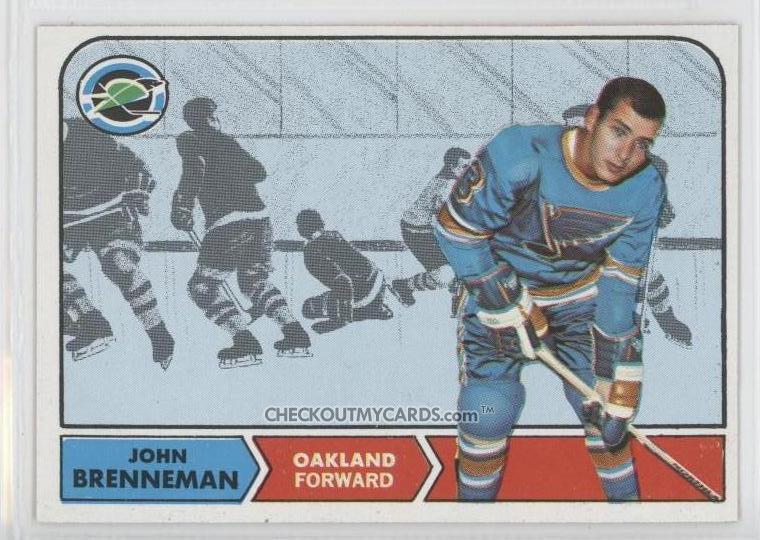
John Brenneman


This is John Brenneman. He was a vagabond NHL/minor league forward. Original Chicago property, he also played with the Rangers, the Red Wings, the Maple Leafs and Seals, never playing a full season in the NHL. The most he played in any one season was 41 games with Toronto in 1966-67.

He was described as a solid winger with excellent speed and was capable of occasional exciting scoring chances. But the slightly built forward did not thrive in physical games. His teammates gave him the ultimate compliment when they said he was one of those guys who came to play every night.

He was popular with teammates too, always looking to enjoy life away from the rink too. Perhaps his coaches over the years did not appreciate Brenneman's taste for the finer things in life, though.

John Brenneman played in 152 NHL games scoring 21 goals and 19 assists for 40 points.

Read more...

Friday

Bob Bailey

Bashin' Bob Bailey was a hard hitting defenseman whose professional career lasted an impressive 17 seasons. In that time he was definitely a hockey vagabond, playing with 14 teams in 7 leagues. That also earned him nicknames such as "Here and There and Back Bob."

Wherever Bailey went he was sure to find trouble. Most infamously he assaulted referee Jerry Olinski during the 1956 Calder Cup playoffs, drawing an indefinite suspension and a fine. On two other occassions in his career he attacked referees, too, including in his final game of his career. On another occassion he was also suspended 12 games for his baseball-swing usage of his hockey stick on Ted Harris.

The Kenora, Ontario born Bailey also found time to play in the National Hockey League during the 1950s, no easy feat back in the glory days of the six team league. Including playoffs he played in 92 games with Toronto over three seasons; 45 games with Detroit over two seasons; and 28 games with the Chicago Black Hawks for one season. He scored 15 goals in 165 games, 15 of which came in the Stanley Cup playoffs.

Another curiosity about Bailey's career: He was traded in exchange for Bill Dineen on three different occassions!

Read more...

Saturday

Hank Goldup


The fact that Hank Goldup did not own his own pair of skates until he was 16 years old did not prevent him from achieving success in the NHL with the Toronto Maple Leafs and New York Rangers in the 1940s.

Conn Smythe first noticed Goldup as a 17 year old when he scored 29 goals in just 16 games in his hometown of Kingston, Ontario. Smythe signed him up and brought him to Toronto to continue his amateur career. 

Goldup ended up playing at Northern Vocational school in Toronto along side Herbie Carnegie. Swivel Hips Carnegie was as fine a hockey player in the country at that time, but he would not be destined for the NHL due to his skin colour. Carnegie was the son of Jamaica immigrants. But in this season the two worked magic together, with Goldup averaging 2 goals per game. 

Speedy Hank would move on to star with the Toronto Marlies, leading the entire OHA in scoring with 25 goals and 41 points in just 14 games. 

Goldup finally signed a pro contract with Smythe's Leafs in 1939. He started the season with the AHL Pittsburgh Hornets but finished the season in Toronto alongside fellow newcomer Pete Langelle and veteran winger Gus Marker. 

Impressions of Goldup's first NHL games were mixed at best. He scored 6 goals in 21 games and newspaper reports at the time suggested he showed little interest in playing defensively. But by playoff time he was turning into a star, scoring 5 goals (including a couple of game winners) in 10 games, tying Syl Apps for the playoff scoring lead. Newspapers changed their tune, proclaiming "Hankus Pankus Goldup" as "the most consistently dangerous puck pusher" on the team. Another paper said Goldup "makes Houdini look like a rookie."

The New York Rangers would win the Stanley Cup in 1940, but Goldup had made his impression in the NHL. It was a good thing, too. He would never recapture that playoff magic in the next couple of seasons in Toronto, thanks in part to a nasty hip injury when he crashed into the immovable goal posts of the day. Still, he was a member of the Leafs amazing 1942 Stanley Cup championship team.

While the Leafs grew impatient with him, the Rangers remembered his previous exploits and gave him a chance. They traded future Hall of Famer Babe Pratt for Goldup and Red Garrett. Pratt would go on to greatness, while Goldup and Garrett went on to serve in World War II shortly thereafter. Only Goldup would return. 

Goldup rejoined the Rangers in 1945 but only for a season and a half before being demoted to the minor leagues. His stay there was successful but short thanks to injuries suffered in a summer softball game. Torn ligaments all but ended his playing days in 1947.

Goldup retired and became a salesman for Molson Breweries and Andres Wines. Later he served as a sales executive for Victoriaville hockey sticks. He stayed involved with hockey by coaching youth, including his own son Glenn who would go onto his own NHL career in the 1970s. 

Hank Goldup suffered a stroke in 2002 and for the final three years of his life he lived in a care facility, unable to communicate verbally. But legend has it when the Stanley Cup dropped by for a visit Goldup whispered the trophy's name.

"Those were the clearest two words I heard him speak in years," Glenn said. 

Hank Goldup died in 2008.

Read more...

Monday

Teeder Kennedy

The Montreal Canadiens loss turned out to be the Toronto Maple Leafs gain, even if Conn Smythe didn't think so at the time.

The Canadiens were the first to discover the hard working Ted Kennedy, and offered to pay his living and schooling expenses if he would come to Montreal to play junior hockey. However a homesick Kennedy quickly grew tired of the junior team's bumbling of his living and schooling arrangement, so Kennedy packed his bags and headed back to his native Port Colbourne, Ontario

Once he arrived at home he met an old NHL warrior by the name of Nels Stewart. "Old Poison," as he was known, was coaching a senior team in the area and offered the 16 year old Kennedy a chance to play. Stewart took Kennedy under his wing and helped to polish this diamond in the rough.

Stewart would later recommend to the Leafs that they should take their chances on his young protégé. The Leafs, being run by Frank Selke while Conn Smythe was overseas fighting on the front lines of World War II, traded a highly thought of young defenseman in Frank Eddolls to Montreal for the rights to Kennedy.

Smythe was very angry at the move. Feeling like Selke and the Leafs were abusing their authority in his absence, and he loathed the trade from day one. The trade led to the deteriorating relationship between Smythe and Selke, which eventually led to Selke's departure to Montreal.

As much as Smythe hated the deal, even he would have to admit in hindsight that it was perhaps one of the most lopsided deals in franchise history. Eddolls would play in the National Hockey League with little fanfare for 8 seasons, while Kennedy would go on to become one of the all time greats.

Universally known as Teeder (a nickname that stuck since childhood because some people had trouble pronouncing the name Theodore), Kennedy was the ultimate Leaf. While he was a horrendous skater, he made up for it with his competitive zeal that would make him arguably the greatest leader in franchise history, and maybe in hockey history. He led by example, fearlessly battling some of hockey's all time greats. He could shoot and pass and stickhandle with the best of them, yet was a proud defensive player and a superior faceoff specialist.

Kennedy grew up dreaming of playing for the Leafs and idolizing the great Charlie Conacher. Needless to say, Kennedy was ecstatic when his dream suddenly became true. But come game time he was totally focused, and always played every game at the highest level. For Kennedy every game was played with a level of desperation as if it were game 7 of the Stanley Cup finals. Very few players in league history can have that said about them.

Kennedy broke in with the Leafs in 1943-44. His arrival was well timed as several veteran players were called upon for war duty. Kennedy, too young for war duty himself at the time, stepped in and contributed 26 goals and 49 points in 49 games. Yet it wasn't his offense but his hustle that earned him the most admiration. There was no doubt this man would one day be captain of the Blue and White.

Kennedy led the Leafs to an upset victory against the Montreal Canadiens in the 1945 Stanley Cup finals. The Canadiens were a powerhouse led by the unthinkable exploits of Rocket Richard. The Habs top line of Elmer Lach, Toe Blake and Richard - who scored 50 goals in 50 games that season - finished 1-2-3 in scoring during the year and were supposed to tear Toronto apart. But a wondrous defensive effort by a line centered by Kennedy (flanked by Bob Davidson and "Sudden Death" Mel Hill) kept the feared Punch Line at bay for much of the series. In the mean time Kennedy contributed a playoff leading 7 goals to capture the silver chalice.

It was in the playoffs that Kennedy was at his best. Although he put up impressive scoring totals throughout his career, he was hockey's version of Mr. October. In 1947 the Leafs captured another Stanley Cup, thanks Kennedy's cup winning goal against Montreal. The Leafs would repeat as champions in 1948, as Kennedy scored a playoff high 8 goals and 14 points. The following season Syl Apps - to that point probably the most revered Leaf in team history - retired and Kennedy, just 22, became the youngest captain in club history. Even without Apps, Kennedy would lead the Leafs to the first ever Stanley Cup "three-peat".

The Leafs would win again in 1951, making it 4 out of 5 years with the Cup. They were upset in the 1950 Stanley Cup final, otherwise they would have won 5 consecutive Cups and be remembered - as they should still be - as one of hockey's greatest teams.

A very famous - or perhaps infamous - incident occurred in that 1950 showdown with Detroit. The soon-to-be legendary Gordie Howe was just a young player but he had the word special written all over him. But his great career - and perhaps even his life - were put in jeopardy in the opening game of the finals. Gordie Howe attempted to throw Kennedy off balance. Howe missed as Kennedy pressed forward, forcing Howe to tumble face first into the boards. A horrified crowd watch the superstar being carried off the ice with a badly broken skull. Kennedy and the Leafs of course claimed it was an accident, but Red Wings of course claim it was a deliberate attempt to injure. To this day there is question to this horrific incident as no video or photo evidence of the collision exists.

The Leafs began the inevitable fall from the top as the 1950s progressed while Detroit and Montreal became hockey's top teams. Kennedy's already atrocious skating became slower and his game declined a step as well, although in 1954-55 - in his last full season in the league - he was named as the most valuable player. The award was perhaps more of a sentimental life time achievement award than anything, but Kennedy deserved the honor.

Kennedy would retire at the end of that season, but would attempt a comeback with the leafs in 1956-57, playing 30 games Kennedy retired with 696games played. In that time he scored 231 goals and 329 assists for 560 points. In the playoffs, this 5 time Stanley Cup champion scored 29 goals and 60 points in 78 contests.

As a kid Ted Kennedy just wanted to play hockey, but never imagined he would ever be inducted into the Hockey Hall of Fame. In 1966 hockey's elite immortalized the hustle and success of Teeder Kennedy by his inclusion in the Hall - hockey's highest honor.

Read more...

Dave Keon

Dave Keon, known as one of the greatest two-way centres in the history of the game, was an amazing athlete who spent 22 seasons in professional hockey. He appeared in an impressive total of 1,725 regular season and playoff games in both the WHA and the NHL, and in all that time he picked up only 151 penalty minutes!

Keon attended the famed St. Michael's College in Toronto prior to turning professional. When he arrived he was a scoring sensation who paid little attention to defense, but that changed by the time he graduated from the Maple Leafs training camp. Keon, under the guidance of Father David Bauer and Bob Goldham, transformed himself into the epitome of a perfect hockey player. He combined skating and stick handling gifts with superior hockey sense in all zones of the rink, both offensively and defensively. He became so good that he was the pre-eminent checking center while remaining a top offensive force.

At 5'9" and 165 pounds Keon was hardly a big man, which often made his task of shutting down the opposition's top scorer that much tougher. But Keon was tough in his own way. He was strong though slight, and mastered the art of angling opponents out of harm's way. While no one questioned Keon's heart or toughness, he always preferred to play within the rules. He won the Lady Byng as the NHL's most gentlemanly player in both 1962 and 1963. In fact he averaged only 6 minutes in penalties in each of his NHL seasons.

Keon hit the Garden ice in 1960 without spending a minute in the minors - a rare feat in those days as boss Punch Imlach was usually dead set against using unpracticed players on his veteran laden team. All eyes were focused on the speedy youngster to see if he could handle the rough stuff. By season's end he had 20 goals, a considerable sum in those days, and was named the Calder Trophy winner as the best rookie in the league that year.

Keon was a sparkplug who ignited the Maple Leafs. The following season saw Keon scored 61 points and was named to the Second All Star team in just his second year. More importantly, he began proving himself where all of the game's greats are made or broken - in the Stanley Cup playoffs Keon helped the Leafs capture their first Stanley Cup championship in 11 seasons.

The Leafs would three-peat as Stanley Cup Champions. In 1963 Keon's 7 goals and 12 points paced the Leafs. In 1964, Keon repeated a team leading 7 goals, including all three of the team's goals in the final game in the semi-final against Montreal. He then turned his attention to shutting down the Detroit Red Wings.

In a surprise championship, the Leafs captured their 4th Cup of the decade in 1967. Keon's relentless checking and premier faceoff abilities were first and foremost, and he was rewarded with the Conn Smythe Trophy as the league's most valuable playoff performer.

Shortly after the 1967 championship, the Leafs headed into transition. The team aged into decline, and a new man rose to power in Toronto in 1971 - Harold Ballard.

Ballard's clashes with players, coaches, media - pretty much everybody and anybody - are as legendary as they are infamous. Perhaps no player's battle with Ballard went as deep and long lasting as Keon's.

Keon was named as captain in 1969, but when Ballard arrived he didn't support Keon as the captain of his hockey team. Keon undoubtedly had an abrasive personality, but was extremely popular with the fans, and was understood by his teammates. As their public battles continued, the Leafs fortunes under Keon's captaincy went downward. Keon himself continued to excel, but he didn't have the supporting cast to help him.

Ballard could have traded away Keon (one common rumor had the New York Islanders very interested) but he refused by asking for the moon and the stars in return. Ballard wanted Keon right out of the NHL and when his contract was up in 1975 he left Keon with little choice but to sign with the World Hockey Association - something Keon remained bitter about years after Ballard's death.

Keon brought his intelligent game to the WHA where he played for Minnesota, Indianapolis and New England over the next four seasons before making his triumphant return to the NHL with the Hartford Whalers, who merged with the NHL once the WHA collapsed.

Keon continued to play until his retirement at the conclusion of the 1981-82 season.

Keon never forgot or forgave Harold Ballard for the way he was treated. Keon felt disrespected and unappreciated in the often public and sometimes deeply personal verbal assault Ballard waged. Keon refused to take part in any Maple Leaf functions for years after his retirement, despite his status as one of the most popular Leaf players of all time among fans.

Once Ballard passed on, the new Maple Leaf regime and particularly Cliff Fletcher looked to repair old wounds with many former players, including Keon. Although the relationship took many years beyond Fletcher's days with the team, the stubborn Keon eventually warmed to the Leafs family and the immense spotlight. He was named as the greatest player in franchise history.

Read more...

Frank Mahovlich


Frank Mahovlich is one of a very select few who would star with Canada's two most cherished sports franchises, the Toronto Maple Leafs and Montreal Canadiens. He also starred with the Detroit Red Wings.

Starting his career in Toronto, The Big M is arguably Toronto's most cherished hockey hero, yet also one of its most criticized.

The Leafs enjoyed their greatest success with Mahovlich leading the way. He helped them to 4 Stanley Cup championships in the 1960s. Mahovlich was a big man with a long powerful stride that powered himself through the opposing team's defense. Add to that his uncanny stickhandling and an overpowering shot, and Mahovlich was pretty much a perfect hockey player.

In his book Maple Leaf Legends, author Mike Leonetti describes Mahovlich:

"Mahovlich moved like a thoroughbred, with a strong, fluid style that made it look as if he was galloping through the opposition. In full flight, he was an imposing figure. An explosive skater, Mahovlich could spot the right moment to turn it on and burst in on goal. He had a great move where he would take the puck off the wing, cut into the middle of the ice and try to bust through two defencemen for a chance on goal. He didn't always get through but when he did he scored some memorable goals. His style of offence caused teammate Dave Keon to remark: Nobody scores goals better than Frank."

Despite the team's great success and Mahovlich's status as one of the greatest of his day, many believed we never got to see the best of The Big M. Most of his best years were spent in Toronto under boss Punch Imlach. Imlach, who could never pronounce Frank's last name, tried to reign in Mahovlich. He and Mahovlich never got along. Imlach was an old stubborn hockey man who was determined to break Mahovlich, who just shrugged off Imlach's antics, although he secretly hurt for years. Therefore, many believed as good as Mahovlich was, he could have been better under a different coach.

Mahovlich tried to become the player his coach wanted him to become as well, focusing on defense more and more instead of going on the attack at all times. This lead to many fans turning against their hero. They had seen how good he could be, why was he holding back so much?

A talented and diverse athlete (he turned down an offer from the Boston Red Sox organization to play pro baseball), Mahovlich entered the league in 1958. That year he won the Calder Trophy as the league's top rookie, beating out another hotshot left winger named Bobby Hull.

Frank played parts of 12 seasons in Toronto. He was a constant 30 goal threat, topping out at 48 in 1960-61 when he played on a line with Red Kelly and Bob Nevin. In that year he actually reached 48 goals with 14 games remaining. Poised to break Rocket Richard's record of 50 goals, Mahovlich inexplicably went into a scoring slump. When talk around the league should have been about the 23 year old's magnificent season, it was all about his year end slump.

Mahovlich and the Leafs would win the Stanley Cup for three consecutive seasons starting in 1962, and capture a 4th title in the much ballyhooed 1967 season. During this time Mahovlich averaged over 30 goals a year, but there was much criticism of him from coach Imlach and a loud number of the fans who bought into Imlach's campaign. It seemed nothing Mahovlich could do was good enough. Things got so bad that the Big M was actually hospitalized with acute tension and depression, and later would leave the game after suffering a nervous breakdown. Described as a shy and sensitive person, the hockey prodigy paid a high price for hockey stardom.

Mahovlich was dealt to Detroit in 1968 in one of hockey's biggest blockbuster deals. Garry Unger and Pete Stemkowski went with The Big M to Detroit in exchange for Paul Henderson, Norm Ullman and Floyd Smith. In Detroit he was teamed with Gordie Howe and Alex Delvecchio on a line that would leave goalies sleepless the night before facing the Wings. Relieved from the pressures of Toronto, Frank enjoyed his best season as a Wing. In 1968-69 he scored 49 goals!

Frank's tenure in Detroit was fairly short-lived as in 1971 he was moved to the Montreal Canadiens and helped them to two Stanley Cup Championships thus giving him 6 rings of his own. He also cherished the opportunity to play with his little brother, Peter. Frank averaged 37 goals a season in 3 full seasons in Montreal. Mahovlich was absolutely dominant in the two Stanley Cup seasons he spent in Montreal, leading the team in scoring in the 1971 playoffs and finishing 2nd in the 1973 campaign.

After 3 years with Montreal he jumped to the World Hockey Association with, somewhat surprisingly, the Toronto Toros and later the Birmingham Bulls. In all he spent 4 seasons in the WHA before retiring in 1978.

His effortless style made some fans wonder if he could have been better. 533 goals and 1103 points, 9 NHL All Star teams and 6 Stanley Cup rings tells you just how good he was.

One of the classiest people you'll ever meet, nowadays "The Big M" is known as Senator Frank Mahovlich. In 1998 he was appointed to the Canadian senate by Prime Minister Jean Chretien.

Read more...

Friday

Wilf Loughlin

Wilf Loughlin was the younger but bigger brother of fellow PCHA star Clem. Wilf was 6'2" 200lbs and played both on the left wing and on defense.

Wilf's followed in his brother's footsteps by playing senior hockey in Winnipeg before joining his brother with the PCHA's Victoria Cougars. Both Wilf and Clem were second team all stars in 1921.

By 1923 Wilf was traded away from Victoria and his brother, but to the NHL. Sold to the Toronto St. Pats (later named Maple Leafs), Loughlin was used sparingly in the 1923-24 season. He only participated in 14 games, scoring no points in limited ice time.

Loughlin played parts of three more seasons with minor leagues in Regina, Edmonton, Winnipeg and Moose Jaw.

Wilf Loughlin died on June 25th, 1966.

Read more...

Dave Farrish

Dave Farrish played in 430 NHL games with the Quebec Nordiques, New York Rangers and the Leafs. He scored 17 goals, 110 assists and 127 points in his career. He won the Eddie Shore award as the top defenseman in the American League in 1982, but at the NHL level he was a decent depth level defenseman with a strong first pass out of the zone.

Farrish got a lot of attention in junior hockey with the Sudbury Wolves, as he was defensive partner of Randy Carlyle. Carlyle was a coveted defenseman out of junior who went on to star in the NHL, winning the Norris Trophy as the league's top defenseman in 1981.

Interestingly, Farrish and Carlyle were not only a dominant defensive pairing but life long best friends. Both would go on to long coaching careers. When Carlyle was hired as the head coach of the Anaheim Ducks, he brought Farrish along too. The duo helped the Ducks win the Stanley Cup in 2007.

"Randy's like family to me, and I would assume I'm like that to him," explained Farrish to HHOF.com. "We have cottages four doors apart on Manitoulin Island and we've got houses about a five-minute walk apart in Anaheim. I'm very blessed that he saw something in me that encouraged him to bring me to the Ducks. I'm indebted to him forever for the opportunity!

Read more...

Saturday

Dmitri Yushkevich

Dmitri Yushkevich was a solid NHL defenseman for over a decade. He continued his career with several seasons back home in Russia, as well.

Yusekvich was trained in Russia in the dying days of the great Soviet hockey empire. Yet he was not a classic Russian defenseman in that he was not a great skater. He was neither speedy or particularly agile. But he was very heady, and could surprise many forecheckers with a smart pass or a deft carry of the puck to make a quick transition from defense to offense. His on-ice smarts were matched by his very good puck handling. These skills plus a heavy shot made allowed him to play regularly on the power play even though h e was not a classic PP quarterback by any stretch.

Defensively he was fit and compact, making him a physical defender. He played the game with a bit of a mean streak, making him far from easy to play against. He struggled with consistency over the course of his career, but then again many defensemen do. He was never an elite player, but rather a solid support player. He was quite adept at blocking shots.


Drafted by Philadelphia, Yushkevich is best known as a Toronto Maple Leaf where he thrived under Pat Quinn. He also played briefly with Florida and Los Angeles. Internationally he was a regular with Team Russia, winning Olympic gold in 1992 and silver in 1998. He also played in 4 world championships (winning gold in 1993), 3 world juniors (winning gold in 1989) and the 1996 World Cup of Hockey.

Yushkevich returned to Russia to play starting in 2003. Perhaps his relatively early exit from the NHL had something to do with blood clotting problems scaring off NHL teams. He returned to Russia, where he found the transition from the NHL more difficult than when he left home for North America over a decade earlier.

Yushkevich continued to play through the 2010 season, briefly retiring to take care of his three children after the tragic death of their mother in 2008. She died in California, reportedly from a liver disease.

Read more...

Tuesday

Sid Smith

Sid Smith was the Toronto Maple Leafs "master of the tip-in" from 1949 thorough 1958. That's how one reporter described the hometown left winger who made a career out of deflecting point shots.

"It became my trademark, in a way." said Smith. "The thing was to keep an eye on the puck coming in from the point or in the direction of the net and just make that slight deflection because it threw the goalie off. He's play it for the shot from the point or wherver its from and I'm just sort of cruising in and making a deflection, or sometimes you caused a problem with the goalie. He'd lose sight of it because you are hanging around."

At 5'10 and 175lbs Smith was of pretty average size for his era, but he couldn't rely on parking himself in front of the net like today's giants do. Instead he had to keep zipping in front of the goalie.

"If you stood still you were going to get knocked on your keester!"

Another difference between now and then was back then the slapshot had still not be invented.

"If it was today, you'd really have to be careful or you're liable to get killed! That slapshot is just treacherous!"

Smith grew up in Toronto admiring the Maple Leafs, but was never noticed until he reached junior hockey. The Leafs never expressed any interest in him, so it came as a suprise to Smith when he learned the Leafs had placed him on their protected list.

"I never knew I was even on the list or anything," he said. "I figured that was just about it as far as making the NHL goes."

After playing some games in the Quebec Senior League, Smith signed with Toronto in 1946 but spent much of the next 3 years bouncing back and forth between the big leagues and minor leagues.

In 1948-49 Smith had a AHL season to remember. He set new scoring records in the top minor league, scoring 55 goals and 112 points! Although he appeared in just 1 regular season game with the Leafs, he was recalled for the Leafs playoff drive. Smith replaced Vic Lynn in the lineup and played on a line with Teeder Kennedy and helped Toronto win the Stanley Cup! Perhaps his most famous game came in game 2 of the Cup Finals against Detroit when Smith scored all 3 Leaf goals in a 3-1 victory.

Needless to say Smith had a spot on the Leafs roster for the next season, and for the next few seasons. He was a constant 20-25 goal threat in an era when that really meant something. Twice he topped 30!

Towards the end of his career Smith slowed down production wise considerably. By 1957 the Leafs had a deal to send Smith to Detroit. Instead, Sid accepted a two year contract as a playing coach with the Whitby Dunlops, a senior club preparing for the world hockey championships.

"I'm kind of sorry in one way and glad in another because we played for a world championship and we won it. On the other hand I would have liked to continue on with my career and score a few more goals. But winning the world championships against the Russians compensated for everything."

In those days the switch from the NHL to international hockey was a shock to say the least. Games were sometimes played on outdoor rinks. Smith recalls having to play in snow and hail. He also recalls the brutal officiating. International referees frowned upon Canada's game of heavy body contact.

"We could hardly make a move. They did not call stick infractions like spearing and slashing, that were an art among European teams. We had more injuries from sticks playing against those European teams than we did in our own league in Canada!"

Smith ranks the experience of winning the world championship as "very, very close" to that of winning the Stanley Cup. "The Stanley Cup is every hockey players dream though" he conceded.

Smith and the Dunlops went on to win the Allan Cup the following year. He attempted to return to the National Hockey Leage in 1960 at the urging of Leafs boss Punch Imlach, but the league did not reinstate him.

After hockey, Smith went into the graphics business. He also formed a NHL Oldtimers hockey club that played games for charity.

Read more...

  © Blogger templates Newspaper III by Ourblogtemplates.com 2008

Back to TOP